
Discovering the relationships within form
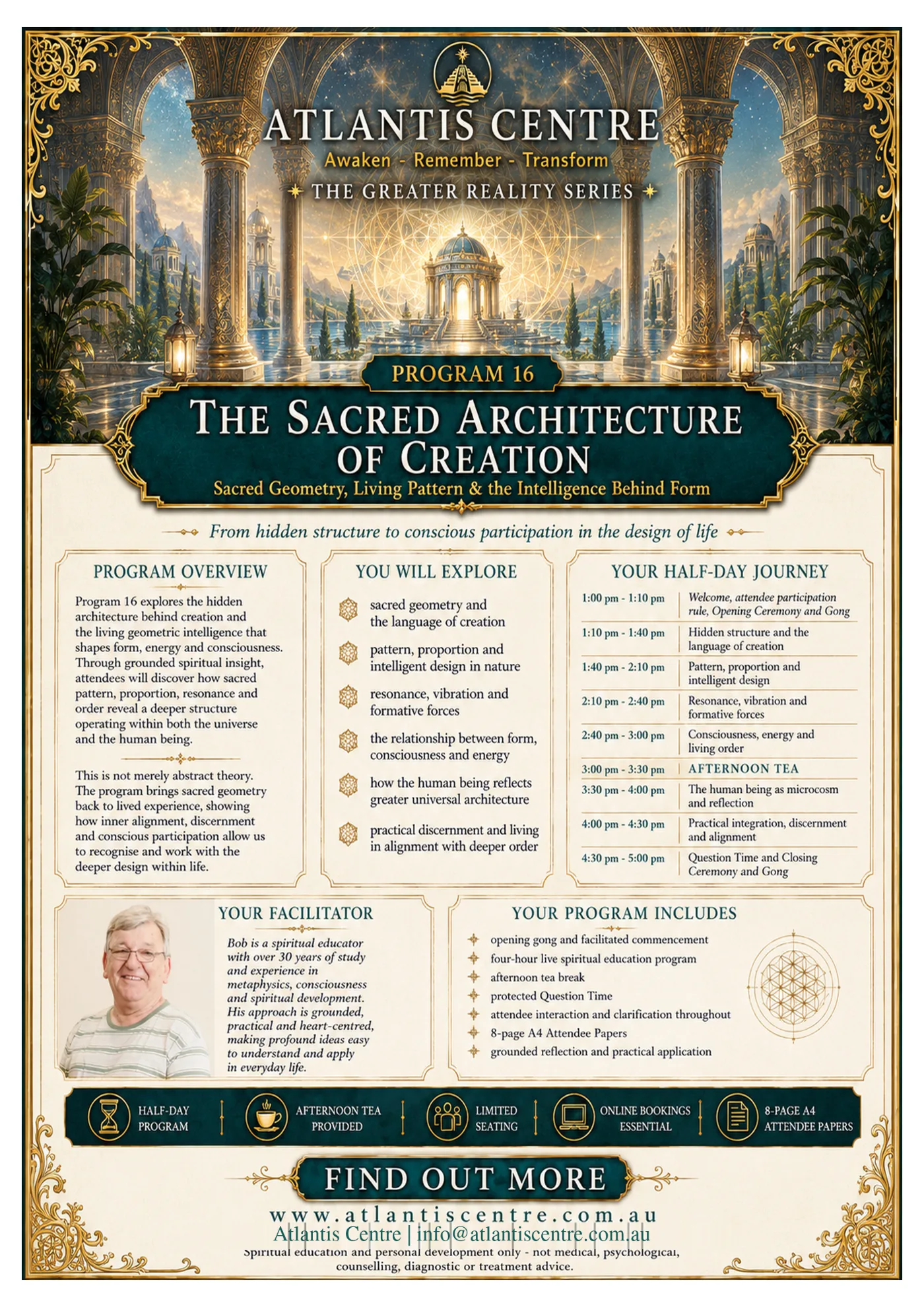
The Sacred Architecture of Creation explores the spiritual meaning of pattern, proportion, resonance and order. Program 16 asks how the forms we encounter may become doorways into a deeper understanding of consciousness and the greater relationships in which we participate.
The advertisement connects sacred geometry, intelligent design in nature, formative forces, energy and the human being as a reflection of universal architecture. The lecture follows a movement from stillness into vibration, rhythm, relationship and form. Its purpose is to help participants recognise these principles inwardly and consider how they might support the work of finding liberation and freedom within themselves.
Sacred geometry as a language of creation
The point, line, circle and sphere give the lecture a simple beginning. A point can suggest origin; a line relationship and direction; a circle the connection between a centre and its boundary. These are used as contemplative forms through which larger spiritual ideas can be approached.
Geometry becomes meaningful when the relationship it expresses is understood. A centre gives orientation, while a boundary gives a field its particular expression. Applied inwardly, this raises questions about identity and participation. What is the centre from which we act, and how can we remain connected to others without losing the responsibility to choose for ourselves?
Triangle, square, spiral and sacred proportion
The triangle develops the relationship between opposing forces and a reconciling third position. The square brings attention to stability and embodiment. The spiral offers an image of development in which a familiar theme may return with the possibility of a different understanding.
The lecture uses these forms to contemplate the organisation of consciousness. Balance can become clearer when we recognise which forces are pulling; growth becomes more understandable when repetition is seen as an opportunity for deeper awareness. Sacred proportion asks how the parts relate to the whole. Each symbol opens an inquiry that the individual must examine through their own experience.
Pattern and the intelligence contemplated in nature
Nature provides patterns of growth, rhythm and relationship through which the program considers a deeper ordering intelligence. The spiritual inquiry is concerned with the meaning such patterns awaken and the perspective they offer on our place within a greater whole.
The manuscript preserves the distinction between observing a form and interpreting it metaphysically. Wonder does not require certainty about every hidden cause. A person can contemplate proportion and interdependence while remaining open to learning. The Middle Path allows the study of nature to encourage humility, attention and a more harmonious relationship with the life that sustains us.
Sound, vibration and formative forces
Sound introduces pattern through time. Rhythm, interval and silence allow a sequence to become intelligible. The lecture considers OM and the creative Word within their spiritual setting, using sound to contemplate emergence, expression and return.
Formative forces extend the question to what gives a pattern its shape and continuity. In the Atlantis framework, vibration becomes a language for considering the movement from potential towards manifestation. The inward correspondence concerns what our repeated attention and expression are forming. Speech, for example, gives an intention an audible shape and carries its quality into relationship with another person.
Light, number and universal resonance
Light brings visibility and differentiation into the program’s account of form. Number concerns relationship, proportion and order. Together with sound, these themes offer a way to contemplate creation as an interconnected expression rather than a collection of unrelated objects.
Universal resonance describes the spiritual possibility that individual forms participate within larger patterns. The lecture asks us to consider what that participation means for consciousness. A person can recognise their distinct place while becoming more attentive to the whole. The practical direction is greater proportion: understanding how a choice affects the relationships to which it belongs.
Flower of Life, grids and energy fields
The manuscript includes the Flower of Life, cosmic energy grids and matrix fields as symbolic and metaphysical ways of exploring interconnection. Repeated forms can suggest continuity, shared centres and the emergence of a larger pattern through relationship.
These images invite contemplation rather than automatic certainty. Their spiritual value grows when they help us recognise how we participate in a family, group or community. Shared patterns are influenced by what each person repeatedly contributes. Awareness of the greater field therefore deepens personal responsibility for the tone, intention and conduct we bring into it.
The human being as a living microcosm
The advertisement describes the human being as a reflection of greater universal architecture. The lecture develops this through the relationships among thought, feeling, will and spiritual orientation. Each has a function, and the quality of the whole depends on how they work together.
Inner alignment may be understood as a more truthful proportion among these capacities. Clear thought needs the warmth of feeling; feeling benefits from discernment; intention needs action if it is to become real. The person becomes a living expression of the principles being studied. Sacred architecture is then encountered within the work of refining one’s own consciousness.
Discernment and conscious participation
The lecture keeps physical observation, symbolic meaning and metaphysical teaching distinguishable. This helps participants explore deeply without allowing an impressive diagram or phrase to replace understanding. A symbol remains a doorway whose meaning has to be considered.
Neutrality supports this process by allowing wonder and questioning to coexist. The Middle Path asks how the teaching affects the person who receives it. Does it encourage clearer awareness, greater responsibility and a more harmonious inner relationship? Those questions bring an expansive subject back to the work that each individual is free to undertake within themselves.
Bringing inner order into expression
A simple example is the relationship between speaking and listening. Too much expression can overwhelm a conversation; too little can leave an important truth unspoken. Recognising the needed proportion allows the relationship to take a clearer form.
Program 16 offers spiritual knowledge through which such patterns can be understood more deeply. Joy may arise in recognising connection, while peace and harmony ask for the patient work of alignment. The invitation is to take responsibility for one’s own life and, if desired, apply that understanding inwardly in the search for liberation and freedom within oneself.