
A wider map of consciousness
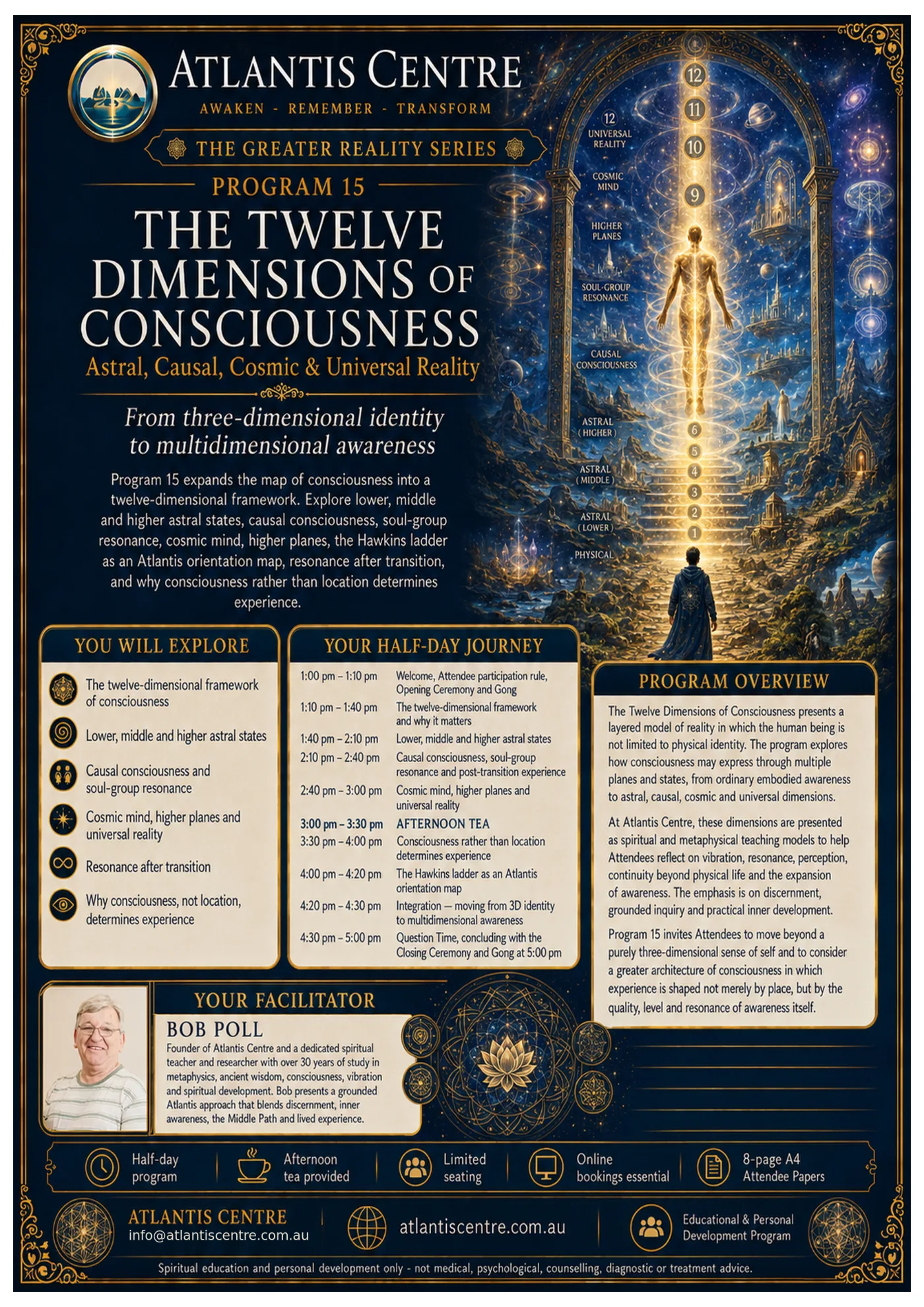
The Twelve Dimensions of Consciousness explores a spiritual framework extending from embodied identity towards astral, causal, cosmic and universal awareness. Program 15 asks how experience may change as the quality and range of consciousness develop.
The advertisement brings together a twelve-dimensional map, lower, middle and higher astral states, soul-group resonance, higher planes, experience after transition and the Hawkins ladder as an Atlantis orientation. The lecture gives these subjects a common direction: understanding what we cultivate within ourselves and taking responsibility for the qualities through which we participate in life.
What a dimension means in this program
Dimension is used primarily to describe a range or quality of consciousness. It helps organise the movement from a strongly physical identity towards wider spiritual participation. The manuscript distinguishes this metaphysical map from measured spatial dimensions in physical science.
The purpose is orientation. A map can suggest relationships and questions without containing the whole reality it attempts to describe. The Middle Path allows the framework to be explored deeply while remaining open to uncertainty. Participants are encouraged to ask what each level means and how the idea assists their own understanding, rather than treating a numbered system as an unquestionable authority.
Embodied awareness and the first three dimensions
The lecture begins its map with density, survival and embodied choice. Earthly life provides a setting in which consciousness encounters physical limits, time, relationship and consequence. These conditions give spiritual qualities an opportunity to become practical capacities.
Polarity plays an important part. Attraction and resistance reveal where attention is pulled, while the neutral position allows the movement to be observed. The person begins to choose with greater awareness of motive and consequence. In this way, ordinary life becomes a meaningful field for spiritual evolution, with the work of consciousness taking place within the conditions already present.
Lower astral states and unresolved attachment
The next movement considers lower astral conditions through emotional density, strong desire and the tendency of consciousness to become absorbed in its own patterns. The manuscript associates these ranges with unresolved attachment, fear and compulsion within its spiritual model.
The teaching invites reflection on how such conditions already have an inward correspondence in life. A grievance can narrow the world around one injury; a consuming desire can make other responsibilities disappear from view. Recognising these movements creates room for a freer response. The focus remains on one’s own development, without using the map to judge another person’s spiritual worth.
Middle astral states and soul-group relationship
The middle ranges are explored through review, adjustment and learning in relationship. As emotional turbulence softens, a wider perspective can become available. The soul may recognise connections that were difficult to see from within a strongly defended personality.
Soul groups are considered as fields of shared learning and resonance across a wider journey. Relationships have significance through the understanding they help develop. The spiritual lesson is to value that meaning while allowing freedom. A deep connection does not require possession, and the form of a relationship may change as the lesson is understood.
Higher astral and causal consciousness
Higher astral states are contemplated through greater coherence and a reduced dependence on personal emotional demands. The causal perspective moves towards the enduring meaning of experience: the qualities and patterns that remain when the details of a particular story have receded.
The lecture distinguishes knowing about a virtue from having developed it. A person may forget the circumstances through which patience was learned while retaining the capacity to be patient. This is central to its understanding of spiritual continuity. The work within ourselves matters because it changes what becomes available in our character and the way we meet experience.
Cosmic mind and universal reality
The wider ranges of the twelve-dimensional framework open into cosmic mind and universal consciousness. Here the individual is considered within a greater order of relationship, with the boundaries of a narrowly personal identity becoming less absolute.
The inquiry preserves the value of the individual life. A recognition of unity should increase the care brought to particular relationships and responsibilities. The program asks how expanded awareness might be expressed through love, humility and service. These qualities give cosmic language a human meaning and return a vast spiritual perspective to the life in which understanding must be lived.
Resonance after transition
The advertisement emphasises consciousness rather than location as the basis of experience. The lecture develops this through resonance: the idea that consciousness may encounter conditions compatible with the qualities it has cultivated, including beyond physical transition.
Within this model, preparation begins in life through what we repeatedly strengthen. Attention, attachment, compassion and clarity contribute to an inner orientation. The teaching is offered for personal reflection, not as a means of declaring another person’s destiny. Its useful question is what we are becoming through our own choices and how that becoming can be met more consciously.
The Hawkins ladder as an orientation map
The Hawkins framework is used to reflect on qualities ranging from contraction and fear towards courage, willingness, love and wider awareness. The lecture places it alongside the dimensional map as another way of considering spiritual direction.
These frameworks are not treated as identical measurements, and participants are not assigned a score. Their value lies in helping someone recognise the quality behind a response. The question is whether that recognition assists a more conscious choice. Growth remains a living process in which a person can examine a pattern and take responsibility for changing their participation in it.
Multidimensional awareness in ordinary life
Program 15 offers a larger spiritual context for the inward work of freedom. A decision to release a grievance, speak honestly or serve without needing recognition may be small in outward appearance, yet significant in the consciousness it develops.
The invitation is voluntary and personal. Through neutrality and the Middle Path, participants can explore the map while remaining grounded in their own lives. Peace, harmony and joy are approached through the qualities they choose to cultivate, with liberation understood as an increasing freedom from the patterns that once directed them automatically.