The spiritual purpose of balance
Finding Balance Within explores how the inner self can remain present amid the opposing forces of human life. Its central concern is the relationship between mind, body, spirit and soul: how these dimensions can cooperate so that deeper understanding becomes a steady influence in daily experience.
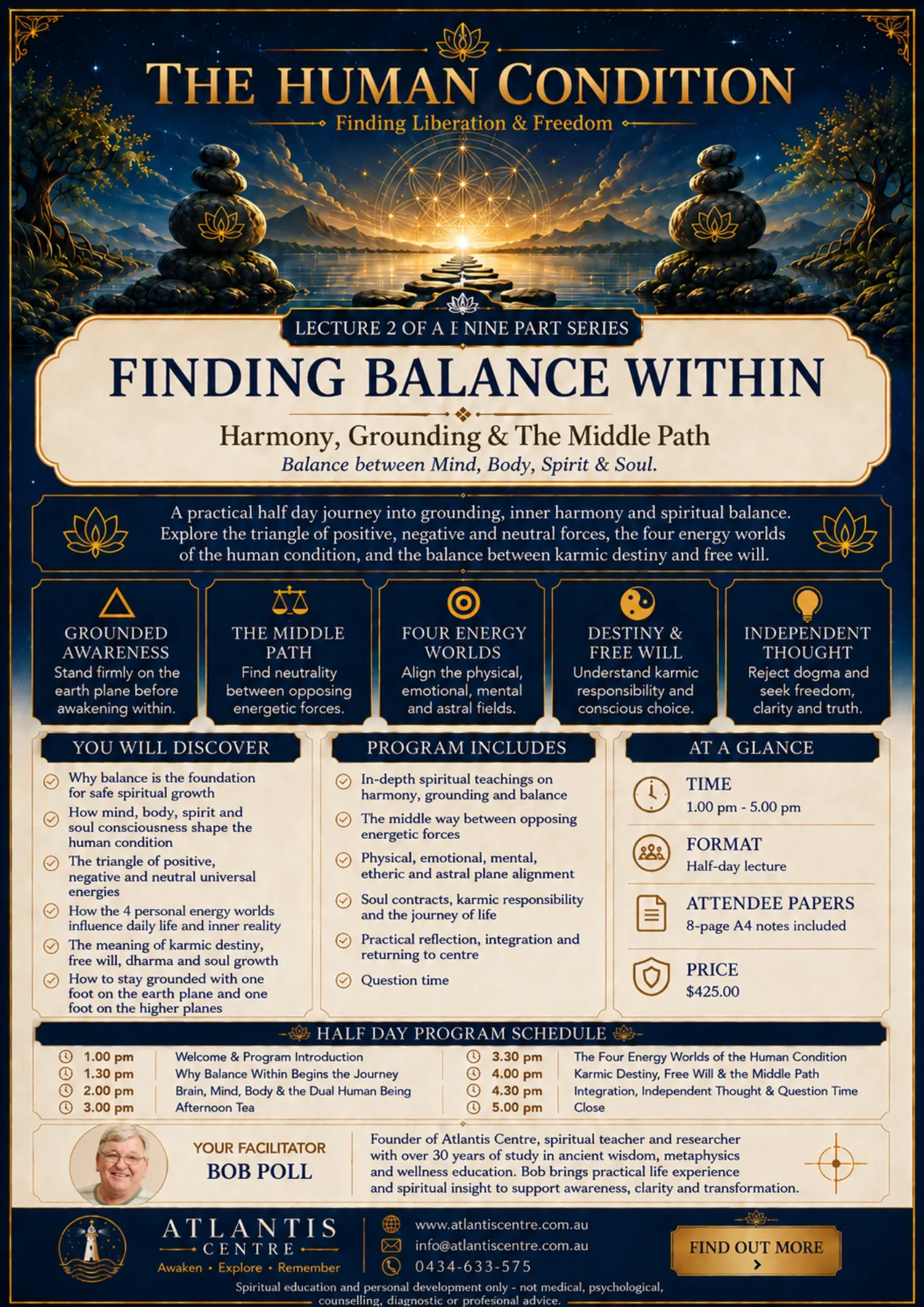
The advertisement brings together grounding, the Middle Path, four energy worlds, karmic destiny, free will and independent thought. The lecture develops balance as a spiritual foundation. Sensitivity and insight become more useful when a person can remain connected to the body, examine impressions clearly and respond without being carried away by every passing influence.
Grounding and the dual human being
The program considers the human being as both an earthly personality and a spiritual participant in a wider reality. The brain and ordinary mind help us organise physical life. The soul’s direction is considered through conscience, meaning and an awareness that reaches beyond immediate personal interest.
Grounding allows these aspects to meet. Attention to the body, ordinary responsibilities and the facts of a situation gives spiritual inquiry a stable place to begin. The lecture’s image of one foot on Earth and one in spirit expresses this relationship. Higher understanding becomes valuable when it can guide a person who is fully present in human life.
Positive, negative and neutral forces
The triangle of positive, negative and neutral energies is a central teaching of Program 2. Opposing movements appear throughout experience: attraction and resistance, expansion and contraction, activity and rest. Each reveals something about the forces shaping our inner condition.
The neutral point introduces a third possibility: awareness that can hold both movements without automatically submitting to either. From this centre we can recognise what each side contains and choose an appropriate response. In spiritual terms, neutrality creates room for a higher ordering intelligence to inform the personality. It is a position of attentive participation, requiring honesty and the willingness to pause.
Walking the Middle Path
The Middle Path gives that neutral centre a lived expression. It asks for proportion: enough openness to learn, enough firmness to preserve integrity, enough compassion to understand another person and enough clarity to recognise what is harmful.
Balance does not mean splitting every difference in half. Sometimes the responsible choice is a definite refusal; sometimes it is patient listening or a change of direction. The lecture asks which response serves conscience and freedom, rather than which response satisfies the strongest emotional pull. This makes the Middle Path relevant to spiritual searching, relationships and the way we exercise personal authority.
The physical and emotional worlds
The advertised four-world model begins with physical experience. The body is the instrument through which our choices enter the world. Rhythm, rest, movement and attention to ordinary needs are part of respecting that instrument. The lecture also discusses etheric vitality as the subtle life principle within its metaphysical account of embodiment.
The emotional world carries feeling, desire, attachment and response. Feeling gives life warmth and significance, but it can also become entangled with an old story. Balance means allowing emotion to be recognised while retaining the awareness to decide how it will be expressed. Compassion becomes clearer when feeling and discernment work together.
The mental and astral worlds
The mental world concerns thought, belief, interpretation and meaning. A repeated assumption can gradually become the lens through which every event is understood. Examining that lens opens space for independent thought and a less automatic relationship with experience.
The astral world is explored through spiritual teachings about imagery, desire and subtle impression. Dreams or strong inner experiences may invite reflection, but their interpretation needs care. Program 2 connects this exploration with grounding, conscience and reason. The four worlds are presented as a spiritual map of the human condition, helping participants consider how different aspects of experience influence one another.
Karmic destiny, dharma and free will
The lecture approaches karma as unfinished energy and consequence seeking understanding. Dharma concerns the higher direction available through right action, service and responsibility. Within this framework, a recurring difficulty can become a place where an old pattern meets a new quality of response.
Soul contracts and pre-incarnation conditions are explored as possibilities within Atlantis teaching, rather than fixed instructions for anyone’s life. The manuscript uses a symbolic balance between destiny and free will to keep both learning conditions and present choice in view. Whatever a person’s spiritual interpretation, they retain the right to act, change a boundary and question an unhelpful explanation.
Independent thought and inner authority
Spiritual balance includes the freedom to question the teacher, the group and our own assumptions. An idea can sound impressive and still require examination. A genuine insight should be able to coexist with clear thinking, personal dignity and the responsibilities of ordinary life.
The lecture describes the heart as an inner sanctuary where conscience and deeper orientation can be rediscovered. Returning to this centre helps us notice when urgency, admiration or fear is influencing a decision. Inner authority develops as we learn to listen carefully, test what we receive and take responsibility for the choices we make.
Bringing the four worlds into cooperation
Suppose someone asks for more time than you can honestly give. The body may signal fatigue, emotion may fear disappointing them, and thought may insist that saying yes is the only kind response. A balanced decision takes all these movements into account.
Offering what is possible, with a clear limit, can join generosity with truth. This is the practical expression of the program’s deeper teaching: mind, body, spirit and soul finding a more coherent relationship. Program 2 offers knowledge for those who wish to do this work within themselves. Through neutrality and the Middle Path, the inward search for peace, harmony, liberation and freedom remains each person’s own responsibility and choice.