
Meeting the person beneath the roles
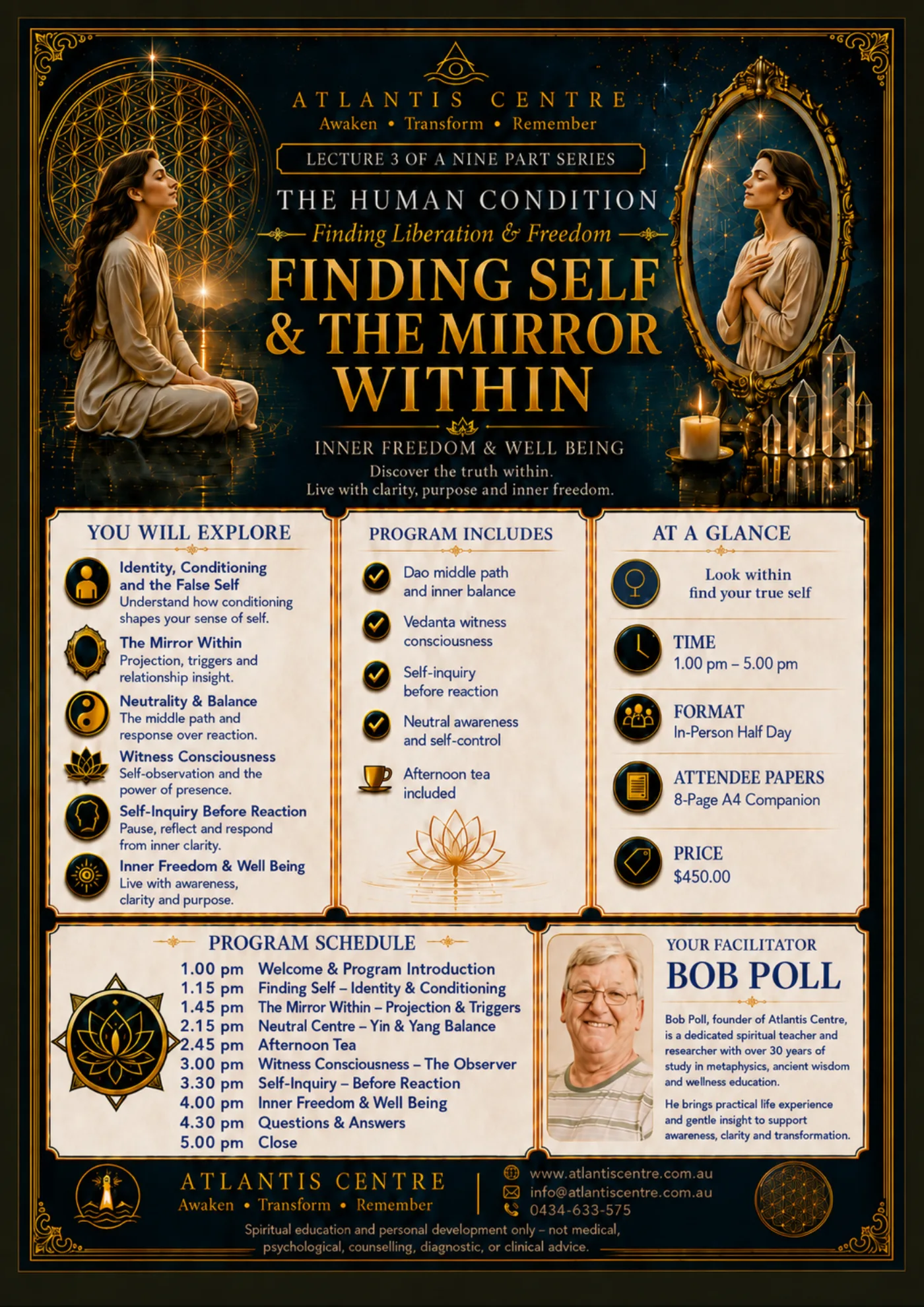
Finding Self and the Mirror Within explores how we come to know ourselves through the reactions, relationships and recurring experiences of ordinary life. Its spiritual focus is the difference between the identity we have learned to present and the deeper self seeking honest expression through that identity.
The lecture moves through conditioning, projection, shadow, relationship mirrors, the neutral centre, witness-consciousness and self-inquiry before reaction. These themes support the advertised movement towards inner freedom and wellbeing. They invite us to understand our own participation in experience while respecting that other people remain responsible for their actions.
Identity, conditioning and the original soul note
Family, culture and experience teach us which qualities receive approval and which seem safer to hide. Over time, these lessons can become a persona: the capable one, the quiet one, the rescuer or the person who must never make a mistake. A role may once have helped us belong, yet later restrict the way we live.
The manuscript introduces the original soul note as a spiritual image for the deeper quality beneath these adaptations. Finding self means listening for that quality again. We begin by noticing where our speech, choices or silence reflect an inherited expectation more strongly than our present conscience.
The mirror as a doorway to awareness
An outer event can reveal an inner movement that was previously hidden. A small criticism may produce a large reaction; another person’s confidence may awaken admiration, irritation or longing. The mirror teaching asks what these responses disclose about our own beliefs, fears and unexpressed capacities.
This inquiry starts with careful distinctions. What happened? What did I feel? What meaning did I add? The external facts and the inner response both matter. Looking within does not require us to excuse unfairness. It gives us a clearer understanding of our response so that we can address the situation without losing ourselves inside it.
Projection, shadow and the golden shadow
Projection occurs when a quality within us is experienced primarily as belonging to someone else. We may condemn a trait we cannot acknowledge in ourselves, or place an admired capacity entirely outside our reach. The lecture explores both movements as opportunities to recover a more complete relationship with the self.
The shadow includes disowned qualities, feelings and motives. The golden shadow concerns strengths we have not allowed ourselves to claim, such as creativity, courage or spiritual depth. Reclaiming either requires honest recognition. The aim is to bring hidden material into awareness and take responsibility for its expression, allowing more of the person to become conscious.
Relationship mirrors, voice and boundaries
Relationships bring different parts of our inner life into view. We may discover a habit of rescuing, a fear of disagreement or a tendency to remain silent until resentment grows. Repeated patterns can show where affection, identity and the need for approval have become entangled.
The lecture connects spiritual growth with the recovery of voice and appropriate boundaries. A person can care deeply while speaking accurately about what is possible or acceptable. Looking at a relationship through the mirror therefore includes two questions: what is mine to understand, and what belongs to the other person’s conduct? This distinction preserves dignity on both sides.
The neutral centre and witness-consciousness
Witness-consciousness is the capacity to observe an inner movement without immediately becoming its servant. Anger can be noticed as an experience; it need not become the whole identity of the person who feels it. The witness creates a small but significant space in which a different response becomes possible.
The manuscript connects this observing centre with the reconciling third force and Nous, or higher intelligence. The spiritual purpose is to make room for conscience and wider understanding. Remaining at the centre allows us to receive the mirror’s information without turning it into self-attack, blame or another claim to spiritual superiority.
The advertisement names the Dao Middle Path and Vedanta witness-consciousness among its foundations. These streams support the program’s inquiry into balance and the observing self. Their place in the lecture is to help participants recognise a centre that can remain aware through changing thoughts and emotions, then take responsibility for the response that follows.
Self-inquiry before reaction
The program gives self-inquiry a clear sequence: notice the fact, the feeling, the story, the motive and the boundary before choosing a response. These distinctions help us see how quickly an event can become entangled with memory and expectation.
For example, being interrupted may awaken an old conviction that our voice does not matter. Recognising that history does not make the interruption acceptable. It helps us respond to the present event with proportion: asking to finish, naming the impact or deciding what conversation is useful. The soul’s freedom grows through this capacity to act with awareness rather than surrendering the moment to an established reaction.
Recovering energy and inner freedom
When a projection is recognised, attention can return from the other person to the quality seeking expression within us. Admiration for someone’s courage may become an invitation to speak more truthfully. Resentment about always helping may reveal a need to stop making promises we cannot sustain.
The lecture describes this recovery as a return towards true essence. Energy is no longer spent defending an image or repeatedly arguing with the same inner story. The personality becomes a more honest expression of the soul. Inner freedom develops gradually as awareness, motive and conduct begin to agree more closely.
A grounded way of finding self
Program 3 invites thoughtful observation of ordinary experiences rather than a search for an impressive spiritual identity. A conversation, a moment of envy or an unexpected feeling can become material for understanding when it is met without exaggeration.
The measure of the work is a more truthful relationship with yourself: clearer awareness, an honest voice and the capacity to respond from your own centre. The program offers knowledge for those who wish to undertake that inward work. Through neutrality and the Middle Path, peace and joy may find more room as understanding develops, with liberation and freedom sought within yourself.