Entering the viewing room
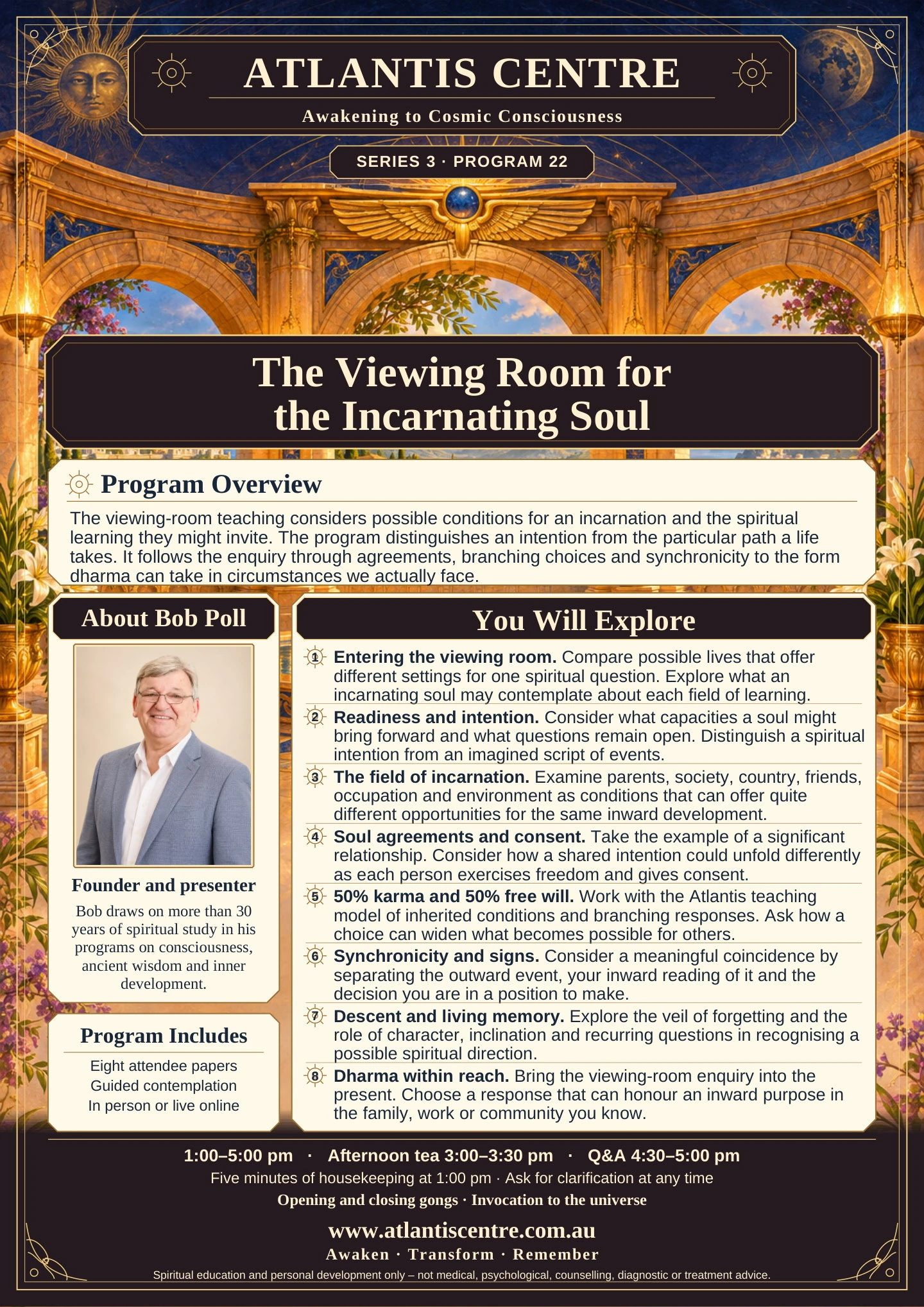
The viewing room is a spiritual image of a soul considering possibilities for a future incarnation. A soul may contemplate a field in which a quality can deepen and find expression. A purpose such as compassion may have several possible forms. The viewing room gives attention to those possibilities before the conditions of body, place and time give a life its particular shape.
The soul’s readiness and intention
Readiness can include a gift that has ripened and an unfinished spiritual question. A soul may see that its strength has a place in a field where it also needs to learn to receive. Intention becomes deeper when the desire to offer something is held alongside a willingness to learn. The lecture considers spiritual purpose through that reciprocal movement.
Families, places and fields of incarnation
Parents, society, country, friends, occupation and environment can each give a purpose a distinct expression. A place may offer a spiritual tradition, a landscape to care for or relationships through which a capacity can be refined. The people who share a field bring histories, needs and freedoms of their own. A purpose imagined by one soul enters a life made with many others.
Soul agreements and living consent
A soul agreement is contemplated as the possibility of an encounter or a direction of learning. The meaning of a meeting can change through the choices of those involved. Present consent, responsibility and care retain their place. The program invites reflection on how a relationship might offer a spiritual opening and how the response belongs to those living it now.
Karma and the conditions already in motion
Karma concerns tendencies and consequences that continue into a field. Some conditions may support a gift, while others bring a question or a limitation into view. The teaching model of 50% karma and 50% free will gives space to inherited conditions and to conscious response. A life may carry unfinished learning and still have room for a new movement.
Free will and the branching field
There can be several ways for a soul to give a quality form. A relationship can deepen through an unexpected change, an occupation can serve a purpose that was first imagined elsewhere, or a different setting can become available. The branching field expresses the freedom of many participants. A spiritual direction can continue while the route through which it develops changes.
Synchronicity and the discernment of signs
A meaningful coincidence can bring an inward question into sharper focus. The event, the meaning we receive and the response we choose can each be held distinctly. A synchronicity may be welcome or challenging. Discernment gives it time to become intelligible and asks which response would honour the circumstances and the freedom of the people involved.
Descent, the veil and living memory
Descent gives a spiritual possibility a body, language, place and time. The veil names the distance between the wider view and a life as it is lived. Spiritual memory may appear through a capacity, a persistent enquiry or a sense of recognition. The instrument of the present life gives such an impression somewhere to deepen through experience.
Dharma in the life within reach
Dharma gives spiritual intention a fitting form within the life actually inhabited. What can be offered with truth and care may be clearer than any knowledge of an earlier agreement. The viewing room leads toward a question that can be lived. What quality is ready to receive a form through the choices that are available now?