
Turning the spiritual map inward
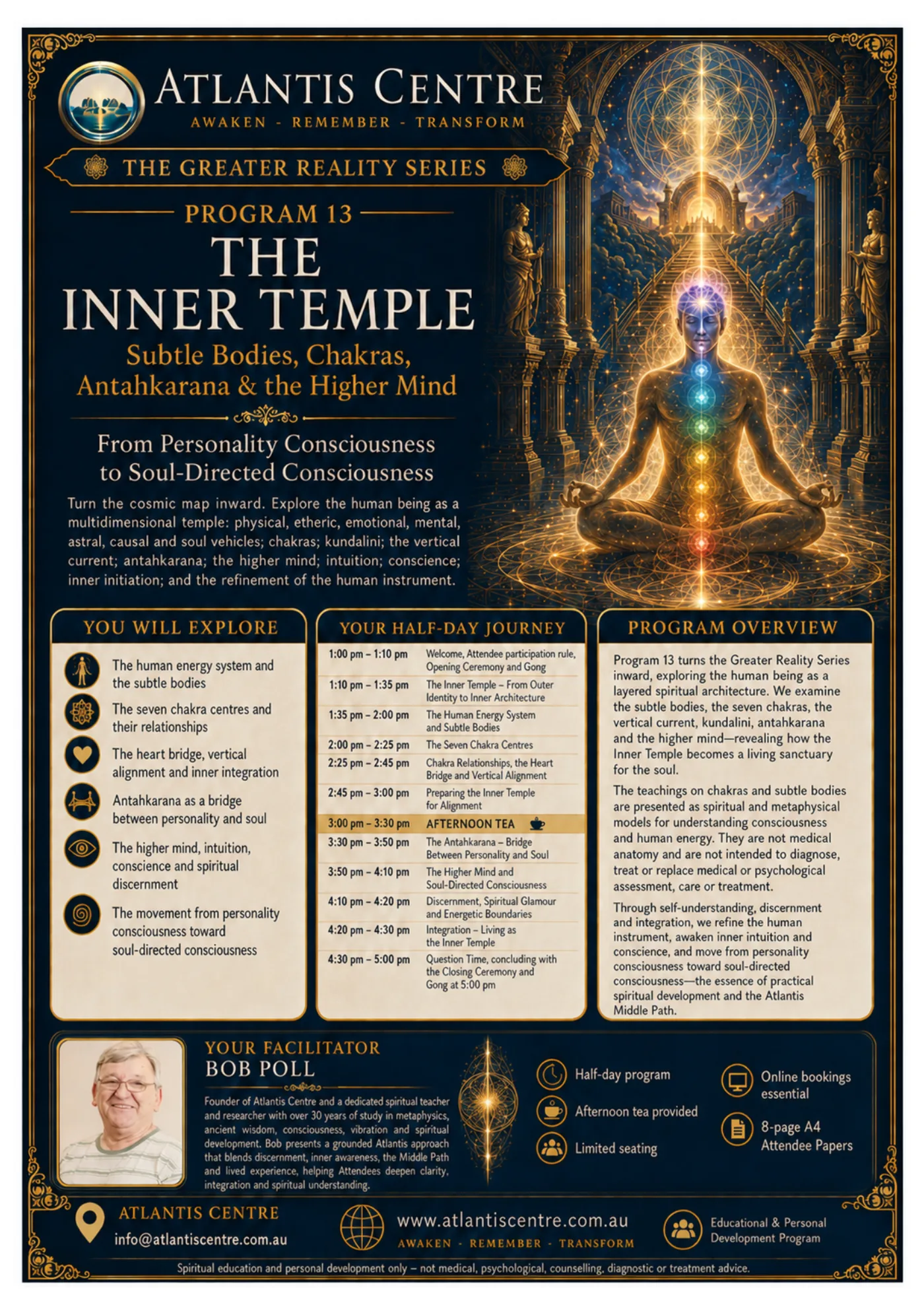
The Inner Temple explores the human being as a layered spiritual architecture through which consciousness finds expression. Program 13 moves from personality consciousness towards soul-directed consciousness, asking how the inner life can become a more coherent instrument for understanding, love and responsible action.
The advertisement names subtle bodies, the seven chakras, the heart bridge, vertical alignment, kundalini, antahkarana, the higher mind, intuition, conscience and inner initiation. These subjects belong to one central inquiry: how we can take responsibility for the qualities developing within us and, if we choose, undertake the work that allows spiritual understanding to enter daily life.
The human energy system and subtle bodies
The program considers physical, etheric, emotional, mental, astral, causal and soul vehicles as a metaphysical map of human experience. The physical body gives action a form; etheric language concerns vitality; the emotional and mental dimensions describe feeling and interpretation. Astral, causal and soul perspectives widen the inquiry into imagery, enduring patterns and deeper spiritual direction.
The lecture asks how these layers cooperate. An insight may be clear in thought while emotion remains unsettled and conduct unchanged. Recognising the difference allows patient integration. The aim is to refine the whole instrument so that spiritual meaning can be expressed through a person who remains grounded and responsible.
The seven chakra centres
The seven chakras offer another way to contemplate this inner relationship. The root concerns grounding and stability; the sacral centre feeling, creativity and relationship; the solar plexus personal power and will. The heart brings love and connection into the picture.
The throat concerns expression, the third eye perception and the crown a wider spiritual orientation. In this program, the centres are spiritual models rather than medical anatomy. Their value lies in what they help us notice. We may speak confidently while struggling to listen, or pursue higher understanding while neglecting ordinary stability. The map encourages a more balanced relationship among these capacities.
The heart bridge and vertical alignment
The heart is explored as a bridge between the lower and upper centres, bringing love and discernment into the relationship between earthly needs and spiritual aspiration. Its task is to help the whole person participate, so that insight remains connected to human feeling and responsibility.
Vertical alignment describes the movement of meaning into expression. A deeper orientation becomes clearer perception, truthful speech, compassionate relationship and appropriate action. Experience can also become understanding through this same inner relationship. The lecture invites us to notice where that movement is interrupted and what would help the parts of the person work together more honestly.
Kundalini, preparation and inner initiation
The advertisement places kundalini within its exploration of the human energy system and spiritual development. In considering this theme, the program’s wider emphasis remains preparation, balance and the refinement of the human instrument. Inner development is approached through the quality of awareness and the capacity to live responsibly.
The manuscript develops initiation as a threshold in understanding. A familiar identity may become too narrow, or conscience may ask for a change we can no longer avoid. Meeting that threshold requires honest participation. Its meaning becomes clearer through the way we live afterwards: with greater steadiness, clearer boundaries and a more truthful relationship with ourselves.
Antahkarana: the bridge between personality and soul
Antahkarana names the inner bridge through which personality and soul can come into a more conscious relationship. The lecture treats it as a spiritual image for a capacity developed through attention, discernment and repeated alignment with deeper understanding.
The bridge is strengthened when an insight changes a choice. A person notices resentment and chooses accurate speech; recognises an error and repairs it; sees the need for a boundary and honours it without hostility. Through such acts, the personality becomes more responsive to soul direction. Spiritual knowledge is gradually translated into qualities that can be relied upon in ordinary circumstances.
Higher mind, intuition and conscience
The higher mind is explored through wider meaning and the relationships that connect separate experiences. It can help us see a pattern without becoming confined to one immediate reaction. Intuition may offer a direct impression, while conscience tests the moral quality of what we intend to do with it.
These capacities work best alongside clear thinking. An impression can be considered without being obeyed automatically. The lecture asks whether an interpretation supports truth, compassion and freedom. This gives inner guidance a grounded place within the person’s life, allowing spiritual openness to mature together with independent judgement.
Discernment and energetic boundaries
Spiritual glamour can arise when the image of being advanced becomes more attractive than the work of becoming honest. Fascination with a symbol or experience may then outrun its meaning. The program returns attention to conduct and the responsibilities that accompany deeper understanding.
Energetic boundaries are considered within that same framework. Connection does not require losing the centre from which we choose. A person can remain receptive while recognising a limit, questioning an influence or allowing another person to find their own way. Neutrality creates the space to listen carefully and act with proportion.
Living as the Inner Temple
The temple is developed through repeated choices. A clearer conversation, a calmer response or a willingness to acknowledge uncertainty can become part of its architecture. The point is to cultivate an inner life capable of carrying insight into the situations where it is needed.
Program 13 offers knowledge for those who wish to undertake this work within themselves. The Middle Path joins spiritual aspiration with responsibility for one’s own life. Peace, harmony and a quieter joy may find more room as the person becomes less divided within, while liberation is approached through the growing freedom to live from awareness rather than automatic reaction.