
Looking beyond the first appearance
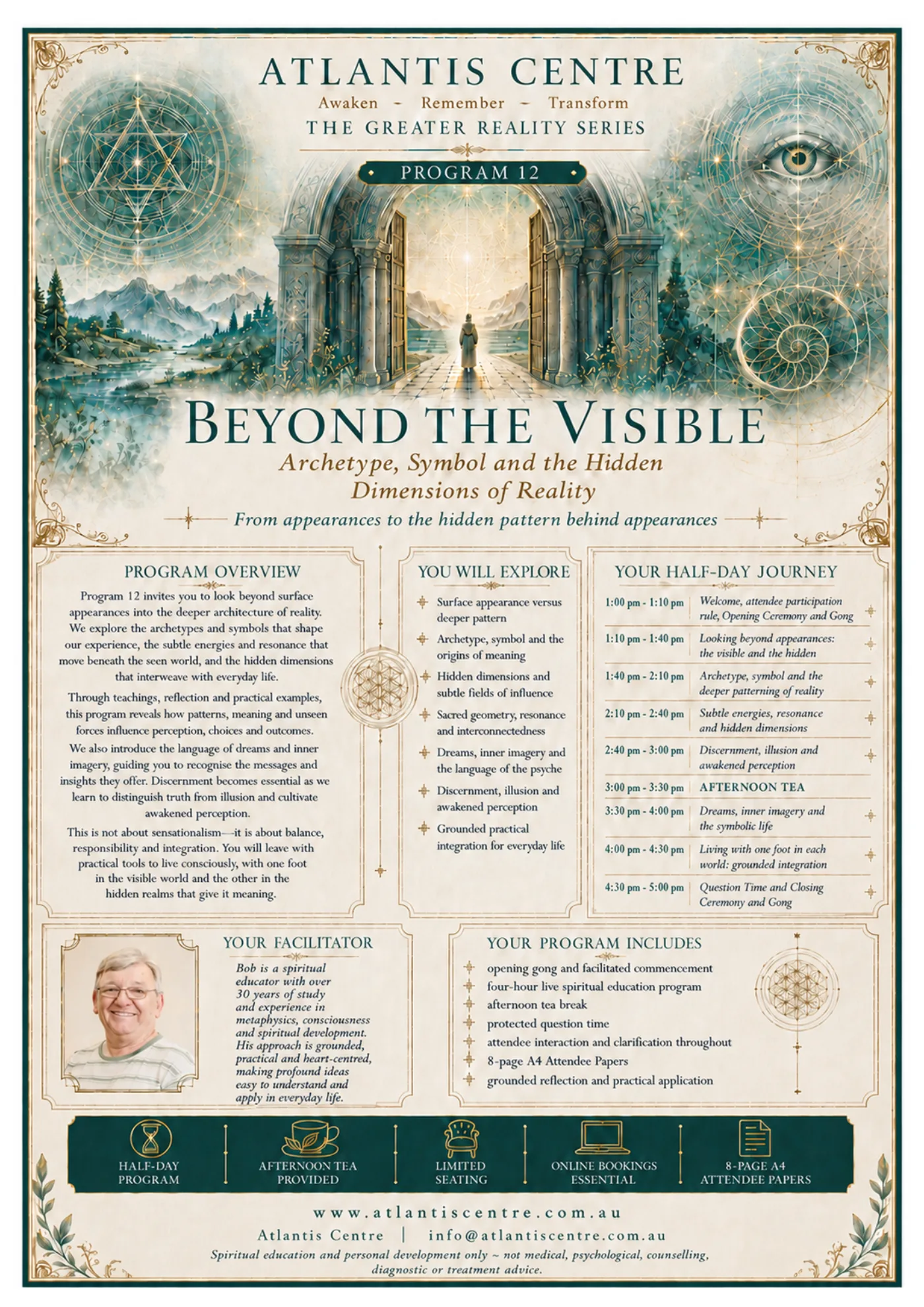
Beyond the Visible explores the hidden patterns through which we give meaning to experience. Program 12 moves from surface appearance into archetype, symbol, subtle fields, sacred geometry, dreams and the discernment required to understand them responsibly.
The advertisement invites participants to live with one foot in the visible world and one in the hidden realms of meaning. The lecture develops this as a balanced spiritual inquiry. It asks what lies beneath our immediate interpretation and how deeper understanding can assist a person seeking greater awareness, harmony and freedom in the life they are actually living.
Appearance, attention and deeper pattern
We rarely notice everything present in a situation. Attention selects what seems relevant, familiar or threatening. An expectation can make one detail stand out while another is missed, shaping the meaning we give to the whole event.
The lecture uses this observation as a doorway into the hidden dimensions of experience. A pattern may have been operating before we became able to recognise it. Increased awareness can reveal the same assumption recurring in several relationships or the same unresolved question beneath different concerns. Seeing the pattern opens a possibility of responding at a deeper level than the immediate appearance alone allows.
Archetypes and the origins of meaning
Archetypes are explored as recurring patterns of human and spiritual experience. The journey, the threshold, the guide and the return can appear in stories, dreams and the way we understand a turning point in life. They offer a language through which a personal experience can be considered within a wider field of meaning.
The program approaches these patterns with curiosity. Recognising an archetype does not settle the meaning of a person’s life. It provides a question: what quality or relationship is being revealed here? The seeker remains responsible for considering the interpretation and deciding whether it brings clearer understanding.
Symbols as bridges to the inner life
A symbol can hold several relationships at once. A doorway may evoke transition, a centre may suggest orientation and a mirror may draw attention to self-knowledge. Its significance develops through context and the response it awakens within the person.
The lecture avoids reducing symbols to a fixed dictionary. The same image can carry different meanings at different stages of life. Spiritual inquiry therefore asks what the symbol illuminates now, how it relates to experience and whether it encourages a more truthful relationship with the self. Meaning becomes valuable when it assists understanding rather than replacing it with a rigid explanation.
Hidden dimensions and subtle fields
The manuscript considers physical, emotional, mental and etheric-astral aspects of experience. Subtle-field language gives the program a way to contemplate atmosphere, inner imagery, intuitive impressions and a wider spiritual relationship between consciousness and reality.
Within the astral model, image, emotion and desire can strongly influence what is experienced. This makes discernment especially important. The appearance of something impressive or frightening does not settle its nature. The Middle Path asks us to remain open while considering different interpretations, preserving reason and grounding the inquiry in what can actually be understood and responsibly applied.
Sacred geometry, resonance and interconnectedness
Sacred geometry explores relationship through form. A circle brings centre and circumference into one pattern; a triangle suggests the relationship between opposing forces and a reconciling position; a spiral can express growth through a returning theme. These forms offer ways to contemplate order beneath appearances.
Resonance widens the inquiry to how patterns meet and reinforce one another. The program asks how our inner condition participates in the atmosphere of relationships and how a greater awareness of connection might change that contribution. Geometry and resonance become spiritually useful when they help us recognise balance, proportion and our responsibility within a larger whole.
Dreams, inner imagery and the psyche
Dreams may bring feelings, conflicts and possibilities into symbolic form. An image can draw attention to something that ordinary thought has neglected or offer a different angle on a familiar concern. The lecture considers this language as one way the inner life can become more available to awareness.
Interpretation remains a personal and careful process. A dream need not be treated as prediction or instruction to be meaningful. Noticing its atmosphere, the associations it evokes and its relationship to current life can provide a starting point. The aim is greater self-understanding while retaining the freedom to question the story we first attach to the image.
Discernment, illusion and awakened perception
Awakened perception involves recognising how desire, fear and expectation can influence interpretation. An idea that flatters us may be especially easy to accept; an uncomfortable fact may be especially easy to dismiss. The lecture invites honest attention to these tendencies.
Neutrality supports that honesty by allowing an impression to remain open long enough for consideration. Conscience, reason, context and the consequences of acting on an interpretation all have a place. The spiritual measure is whether the inquiry helps us become clearer, more responsible and less governed by automatic assumptions. Understanding matures through this willingness to look again.
Integrating the hidden with everyday life
A recurring dream or symbol may encourage you to consider a question about change, belonging or the way you use your voice. Its value grows when reflection leads to an appropriate action, such as a truthful conversation or a more conscious choice.
Program 12 offers spiritual knowledge for this movement between inner meaning and outer life. Joy can be found in discovery, while peace and harmony ask for patient integration. Each person is free to pursue the inquiry at their own pace, using the Middle Path to connect deeper awareness with the responsibility of living it.