
The soul learning through contrast
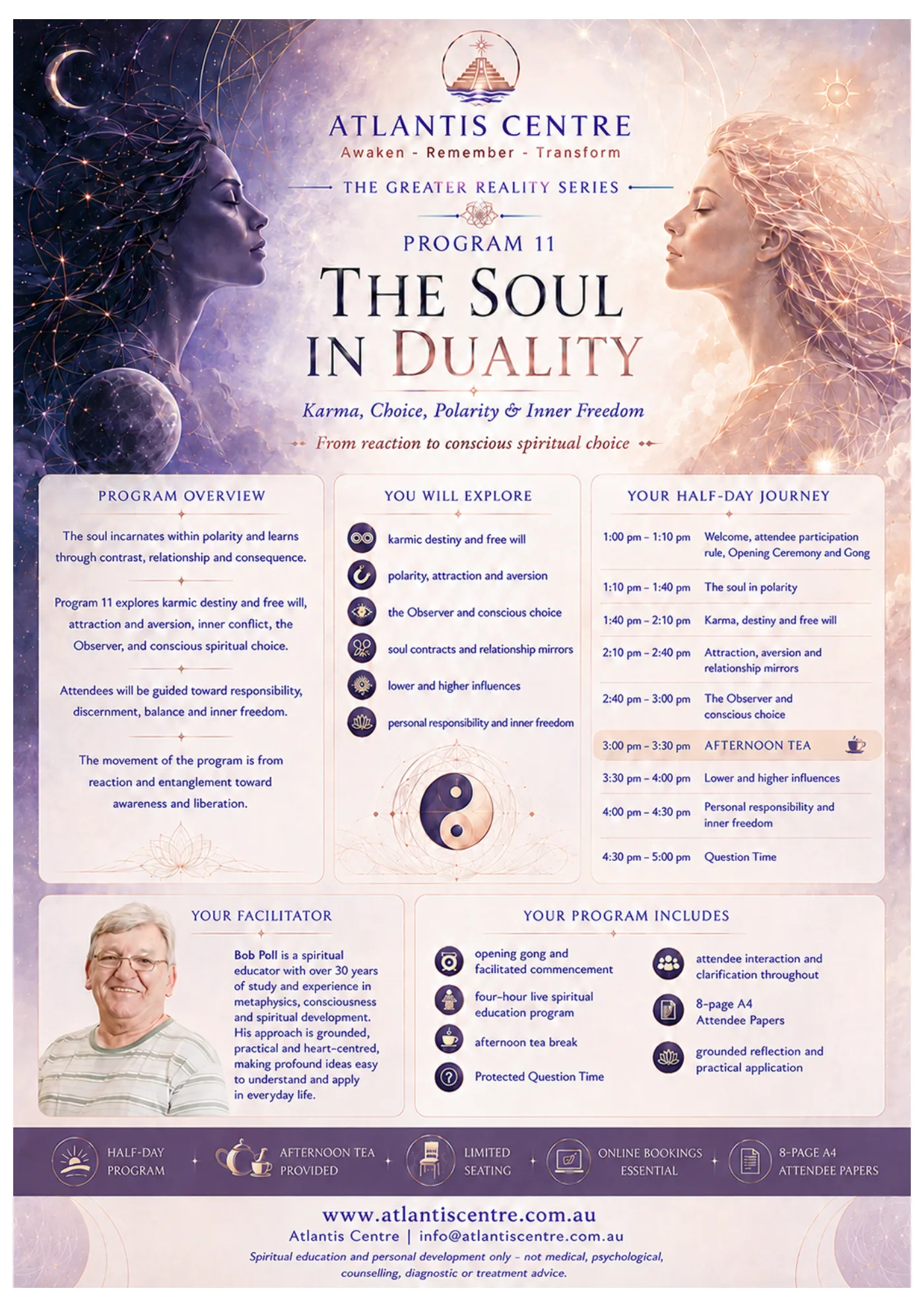
The Soul in Duality explores incarnation as a meeting with polarity, relationship and consequence. Program 11 asks how the soul can become more conscious within conditions that pull the personality in different directions. The advertised movement is from reaction and entanglement towards spiritual choice and inner freedom.
Its subjects include karmic destiny, free will, attraction and aversion, the Observer, soul contracts, relationship mirrors and lower and higher influences. The lecture brings them together around personal responsibility: learning to recognise what is directing us so that a more deliberate, soul-conscious response becomes possible.
Polarity as a field of learning
Human life presents contrasts: gain and loss, closeness and distance, confidence and uncertainty. These experiences reveal our attachments, values and expectations. The lecture considers duality as a spiritual classroom in which the meaning of a quality becomes clearer through its encounter with an opposite.
The aim is to awaken within this movement. Neutrality creates a third position from which the pull of both sides can be observed. We can then act according to conscience and the actual situation. The Middle Path preserves the capacity to feel, care and choose while reducing the tendency to turn every contrast into an inner battle.
Karmic destiny and free will
The program considers karmic destiny as the momentum of conditions, tendencies and unfinished lessons that meet us in life. Some influences are already present before we have the awareness to understand them. Free will concerns the conscious participation that can develop within those conditions.
The manuscript uses a symbolic balance between destiny and choice to keep both in view. Responsibility does not require believing that we control everything. It asks us to identify what is genuinely ours to choose. The spiritual turning point occurs when accumulated habit meets enough awareness for a different response to become available.
Attraction, aversion and hidden attachment
Attraction can draw us towards what we value, but it can also conceal a wish to possess, escape or be completed by something outside ourselves. Aversion may reveal a necessary boundary, an old wound or a quality we have not yet understood. Both deserve attention before they become a decision.
The lecture asks participants to observe the energy behind the pull. What do I expect this person or outcome to give me? What feels threatened when it is absent? Such questions can disclose the deeper pattern without condemning the feeling. Awareness begins to free the choice from the compulsion that previously accompanied it.
The Observer and conscious spiritual choice
The manuscript describes programmed waking sleep as ordinary activity carried largely by unexamined habit. A person may be busy and capable while familiar thoughts and emotional triggers continue to direct important choices automatically.
The Observer introduces another relationship with these movements. A thought can be present without becoming a command; a feeling can be acknowledged without governing the next action. Through observation, the person begins to distinguish what is occurring from what they choose to strengthen. This is central to the program’s understanding of awakening: awareness becoming sufficiently present to participate in the moment where conduct is formed.
Soul contracts and relationship mirrors
The soul-contract teaching considers relationships as possible fields of shared learning across a wider spiritual journey. A person may bring a gift, expose a recurring pattern or call forth a capacity we have not yet developed. The relationship mirror makes our own participation more visible.
The lecture preserves freedom within this inquiry. Spiritual meaning does not require a relationship to continue in its existing form. Completion may involve understanding, repair, a clear boundary or a decision to leave. The question is which response supports dignity and responsibility now, without using an invisible explanation to remove anyone’s right to choose.
Lower and higher influences
The program uses lower and higher currents as a language for different qualities of consciousness. Fear, manipulation and compulsive reaction narrow the field; conscience, compassion and clearer awareness open a wider range of response. These describe movements a person can observe, rather than permanent labels for people.
Influence may arise through our own repeated thinking, a group atmosphere or the interpretations we give to experience. The lecture explores subtle fields while keeping discernment central. The most useful test is the effect of an influence: does it strengthen clarity, freedom and responsibility, or encourage confusion and dependence? Each person can learn to examine that effect for themselves.
Responsibility as a path towards freedom
Freedom develops through practice. At first we may recognise a reaction only after it has happened. With attention, recognition can arrive earlier: during the reaction and eventually before the action. That growing interval creates room for a more conscious expression of the soul.
Responsibility includes repairing what can be repaired and accepting what cannot immediately be changed. It also means being willing to see where a familiar explanation has become an excuse. The lecture invites honest effort without self-condemnation. Inner evolution becomes visible in the increasing capacity to respond with proportion, truth and compassion under real conditions.
Finding peace within the movement of life
Imagine a criticism that usually provokes an immediate defence. The Observer notices the discomfort, neutrality allows the facts to be heard, and conscience helps distinguish useful feedback from an unfair judgement. The response can then be chosen with greater freedom.
Program 11 offers spiritual understanding for this work within the self. Peace and harmony are approached through a changing relationship with polarity, while joy can find more room as compulsive reactions lose their authority. The invitation remains voluntary: each person decides how to apply the teaching and take responsibility for their own inward development.