
Love as a spiritual force
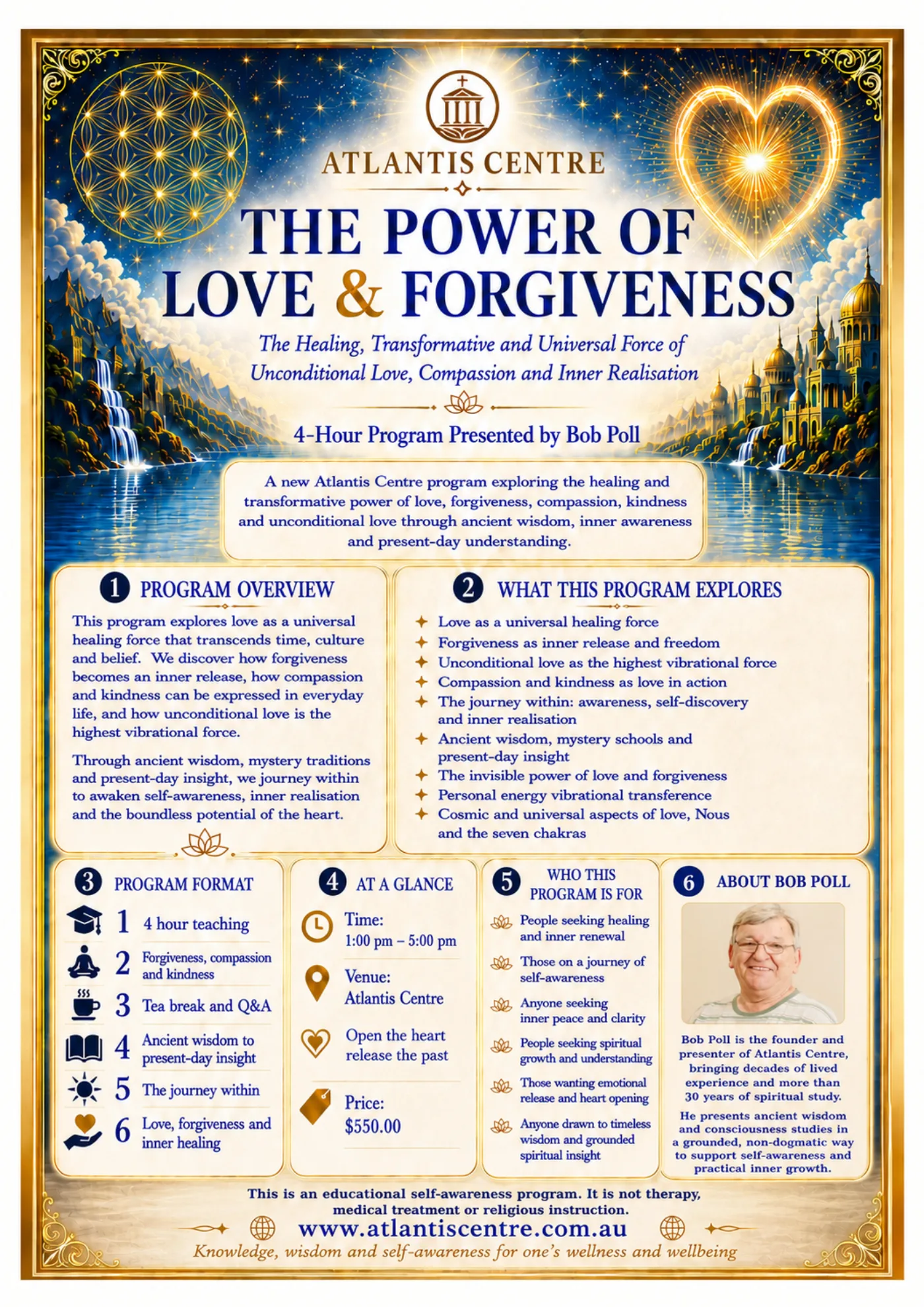
The Power of Love and Forgiveness explores love as a universal principle and a capacity that can be developed within human life. Program 8 brings together unconditional love, compassion, kindness, forgiveness, inner awareness and the relationship between personal energy and a greater spiritual consciousness.
The lecture asks how these teachings can become real within the heart, particularly where life has left disappointment, resentment or a sense of separation. Its purpose is to support a deeper understanding of freedom: the possibility of meeting experience with greater clarity and compassion while retaining self-respect, boundaries and responsibility for our own choices.
Beyond sentiment: unconditional love
Human love often contains affection, need, attachment and expectation. The program acknowledges these familiar experiences while opening a wider inquiry into unconditional love. Within the Atlantis teaching, this is a quality of the soul that recognises the deeper worth of another being without needing possession, reward or agreement.
The advertisement describes unconditional love as the highest vibrational force. The lecture develops this spiritually through love-wisdom: warmth joined with truth and clear understanding. A loving response can include a firm boundary. The inner work is to act without allowing hatred or the wish to dominate to become the centre from which we live.
Forgiveness as release and freedom
Forgiveness is explored as a change in our relationship with what has happened. An event may be over while its emotional charge continues to organise the present. We may rehearse the injury, repeat an argument inwardly or carry an old expectation into a new relationship.
The lecture considers the gradual release of this attachment without denying the facts or removing accountability. Forgiveness remains a personal process; it cannot be demanded on another person’s timetable. Reconciliation is a separate matter, requiring appropriate conditions. The spiritual aim is to recover the energy and freedom needed to live beyond the continuing rule of an old wound.
Compassion and kindness as love in action
Compassion recognises that another person has an inner life as real and complex as our own. It can soften judgement without preventing discernment. Kindness gives that recognition a practical form through the quality of attention, speech and action we offer.
The program connects these qualities with the universal nature of love. Small acts matter because they express the consciousness from which they arise. Listening carefully, speaking truth without cruelty or helping without demanding gratitude can become forms of spiritual practice. Their significance lies in the love made available through them and the responsibility taken for their effects.
The journey within and self-forgiveness
The manuscript returns repeatedly to inner awareness. We can notice where a desire for love is mixed with fear, where kindness has become an attempt to secure approval or where shame prevents honest repair. Seeing these movements clearly is part of learning to love with greater freedom.
Self-forgiveness includes the willingness to acknowledge what we have done and make amends where possible. Remorse can guide change when it is allowed to become responsibility. The lecture distinguishes this from endlessly condemning the self. A mistake can become a teacher as understanding changes conduct and the person develops a more truthful relationship with conscience.
Ancient wisdom and the universal heart
The program draws on ancient wisdom and mystery traditions to contemplate love as a principle connecting the individual with the greater whole. These teachings place the heart within the spiritual journey of the soul, asking how personal experience can become understanding and service.
The manuscript includes the Egyptian image of the weighing of the heart associated with Ma’at. It is used to reflect on truth, inner balance and the weight of what we carry. The question is personal and immediate: which motives make the heart heavier, and which choices bring it into a more honest relationship with life?
Personal energy and vibrational transference
Our inner condition influences the atmosphere we bring into an encounter. Resentment, fear, care and calm attention can each affect how we speak, listen and respond. The lecture explores this through personal energy and vibrational transference, placing familiar experiences of relationship within its spiritual framework.
Awareness makes this participation more conscious. We can notice when a difficult experience is being carried into unrelated conversations, or when our wish to help is becoming pressure on another person. The Middle Path asks for a loving presence that respects both connection and individual freedom. Each person remains responsible for the energy they choose to express.
Nous, cosmic love and the seven chakras
Nous is considered as higher intelligence that can orient the human being towards universal love and clearer understanding. The seven chakra centres provide a spiritual map for how this orientation may be expressed through different aspects of life.
The crown relates to wider consciousness, the third eye to perception, the throat to truthful speech and the heart to love. The solar plexus concerns responsible power, the sacral centre feeling and creativity, and the root embodied stability. The lecture asks how love can move through the whole person. Insight gains substance when it informs what we say, how we relate and the boundaries that support a dignified life.
Peace through the work of the heart
The work may begin with recognising one resentment that is repeatedly being renewed. Understanding its meaning, allowing an honest feeling and choosing a responsible next step can open room for something different. There is no requirement to force a feeling that has not yet become real.
Program 8 offers knowledge and reflection to support this voluntary inward journey. Joy, peace and harmony are approached through the gradual cultivation of love with wisdom. Each person decides how to apply the teaching, taking responsibility for the inner work through which greater freedom may become possible.